

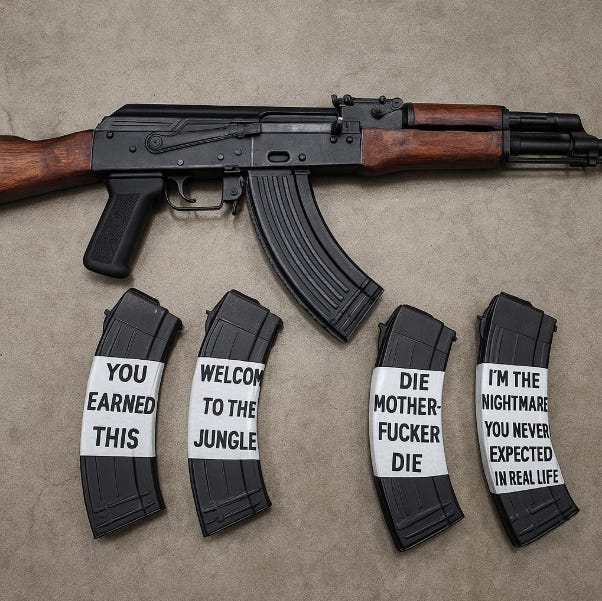
The guns were laid out on a table newly made bare, each one marked in white tape and block letters:
“You earned this.”
“Welcome to the jungle.”
“Die motherfucker die.”
“I’m the nightmare you never expected in real life.”
Steve smiled.
It felt good.
It felt right.
After years of being crushed and spat on, after humiliation stacked on humiliation, he had found a worthy target. Revenge felt almost medicinal. Revenge for the Covid fascists who had come crawling out of the walls. Revenge against the putrid rich who had dismissed him his whole life. Revenge against the smug managerial midwits whose boots he’d been forced to lick at every job he’d ever worked.
He paused, letting memory seep in like slow poison.
How had it come to this?
He was supposed to have been a cop. Five years of training, two degrees, and one last requirement, a two-month state course, stood between him and The Badge. His father refused to pay for it. Drunk daily, slamming doors, pounding tables, sneering “bang-bang university!” every time the subject came up.
That had broken something fundamental.
The dream he was born for met the commandment he could never escape: Obey Thy Father.
He always had.
Obedience would become his undoing.
He fled to graduate school, collecting useless degrees like talismans against despair, until his mother fell ill. His parents needed help. Protection. So he came home.
Biggest mistake of his life.
At first it was tolerable, even peaceful, but the danger signs were already there. One night his father crashed the car into the garage wall. Steve reacted like the policeman he might have been; lowering the garage door, grabbing tools, assessing damage, reassuring his mother. He barely began repairs when his father, instead of collapsing in shame, stormed back out and barked, “Touch nothing! That’s what insurance is for!”
Steve obeyed.
He always obeyed.
Then came the holes in the backyard.
“Hey Dad, want me to fill those in?”
“No.”
So he didn’t.
He cared for his mother as best he could. But she died first, unexpectedly, unceremoniously. And the sisters flew in two days later like vultures, stripping the house bare of everything she owned. Gone. No mourning, no pause, no breath.
Four years followed, four years of hell.
Cleaning feces off the bathroom floor.
Enduring drunken rages.
Fielding orders barked without logic or meaning.
A flood hit the basement and receded. The old white paneling turned brown, then black. Steve began removing it, applying knowledge from his warehouse work; mold meant danger and liability. His father staggered in and screamed, “NO! PUT IT BACK!”
“But Dad, it’s molding. If you want to sell—”
“That’s for the next guy,” his father muttered, stumbling away.
Steve whispered, “I’m the next guy…”
Then came the cancer. Hospice. Cop shows on TV, like when Steve was a kid. Pain twisting inside him, memories of the life he was supposed to have.
And then came Covid.
The world lost its mind.
The warehouse announced impending shutdown.
Masks went from “useless” to “mandatory.”
Petty tyrants discovered their inner stormtrooper.
His father’s dying instruction: “You need to get out of the house.”
Obey thy father.
“Yes sir.”
At the DMV, brain fogged from exhaustion, he botched a simple math question. A kind stranger whispered the answer. The clerk, smug and parasitic, wouldn’t help. Then a DMV worker chased him out screaming “Six feet apart! Six feet apart!” even as she stood a foot away.
He snapped: “Fuck you!”
She smirked. “You wish.”
The thought flashed: he could kill her with a single strike. He had the training.
He didn’t.
He walked away. Again.
In the cramped apartment where he’d stored the remnants of the home he’d saved, he still didn’t feel the loss fully. Not yet.
He obeyed.
It must have been God’s plan, he told himself.
Somehow.
The day his father died, the sisters returned. The VA sister smiled sweetly, “Give it all to the veterans, Steve. You want to help veterans, don’t you? We’re here for you!”
Of course he did.
Within 24 hours the house was gutted. Every object gone. Steve was working at the terminal warehouse, unable to intervene. The house sold instantly to a neighbor, who flipped it a month later for double. His sister called, gleefully, to tell him.
Then came the vaccine push. Every radio station, every talking head, every celebrity labeled people like him monsters, killers, for refusing an experimental shot. His sister joined in the chorus.
He dove deeper into Russian studies as a refuge; music, language, culture, a civilization he respected.
Then came Ukraine.
The Covid fascists became Ukraine fascists overnight. Everything Russian became “evil.”
Enough. Steve cracked.
He began buying guns and gear.
Planning revenge.
Planning an end to everything.
As Western governments dumped weapons into Ukraine, the black market filled. Steve outfitted himself completely:
body armor
thousands of rounds
two semi-auto pistols
an AK-47 with extended mags
a tactical vest
night vision
The plan was simple.
Start with the DMV; only the workers, no civilians.
Then the upscale restaurant packed with genocidal zionists where the converse rule would apply. And last in line? The neighbor who had helped destroy him.
Marching down the street, longcoat hiding the arsenal, he felt a terrible peace.
Then the bomb went off.
A truck smashed through the gates of Our Lady of the Yelps Girls School. Armed men in dresses and armor, screaming slogans he’d heard on the news, rushed the school, smashing doors and glass, prying at locks with a crowbar.
Something ancient and righteous ignited in Steve.
A current surged through him. His longcoat hit the ground. He vaulted the fence in one effortless motion.
He attacked.
With precision.
With fury.
With purpose.
The transterrorists never had a chance. His aim was perfect; rage sharpening sight, adrenaline firing muscle memory he hadn’t used in years. Mercy wasn’t an option. None was expected.
Blood everywhere.
Regret nowhere.
And then it was over.
He sat down, rifle across his knees, waiting for the sirens.
They called him a hero.
Interviews, medals, praise from strangers.
But one question always came, and he never answered:
How did you know?
He didn’t.
Not really.
He only knew that, for the first time in his life,
the cop he was supposed to be
finally came home.